 Basebridge
 transaction hashes help distinguish source confirmation from completed delivery
Basebridge transfer completion requires matching destination evidence alongside a successful source transaction. Start with the transaction hash and the network where you submitted it. The source receipt shows whether that transaction executed, while a compatible bridge tracker can identify remaining processing. A destination transaction or transfer record then connects the movement to the receiving account. If that connection is missing, an unchanged wallet balance alone cannot distinguish an unfinished transfer from a display problem.
Updated ·
A successful source transaction confirms local execution; delivery requires matching evidence on the destination network.
Source execution leaves destination delivery as a separate event
When a transfer crosses networks, the source transaction records an action on the starting chain. Destination execution happens separately. For standard deposits into Base, a source event supplies information the receiving network processes into a deposit transaction. That separation explains why a successful source receipt can appear before the receiving balance changes.
Keep the originating hash attached to its network. A destination hash identifies a different transaction, so pasting the original hash into another network’s explorer may return nothing. Matching the records requires the bridge message or transfer details connecting them. Similar timestamps and amounts help narrow a search, but they do not establish that connection by themselves.
The original transfer route determines which status matters
Without the route used for the original transfer, a status label may describe the wrong process. Recover the selected networks, receiving address and asset from the transaction details or saved transfer record. The starting contract also helps identify the mechanism involved.
A standard withdrawal and a transfer fulfilled through another bridge can have different completion requirements. An interface tracking one mechanism may not recognize a transaction submitted through another. An empty search result therefore does not establish that funds disappeared.
Preserve any transfer identifier alongside the transaction hash. They may identify different objects: the transaction is an onchain execution, while a bridge identifier can connect its associated records.
Why does the transaction hash return no result?
A hash can return no result because the lookup uses the wrong network, the transaction remains unconfirmed or the service has not indexed it. Check the full hash, including any characters hidden by an abbreviated wallet display. Also distinguish the production network from its test environment.
The standard transaction receipt query returns no receipt for a transaction that has not entered a block. A missing receipt therefore differs from a receipt reporting failure. The former leaves execution unresolved; the latter records an unsuccessful execution. On Base Flashblocks endpoints, base_transactionStatus checks whether that node knows the transaction before block inclusion. An Unknown result does not establish failure.
If the wallet still shows a pending submission, preserve that record while checking its status. Creating another transfer does not resolve uncertainty about the first one.
Receipt fields distinguish execution from the intended transfer
A receipt provides execution evidence, but interpreting that evidence requires the transaction details and the contract events it produced. The transaction destination may be a bridge contract rather than the eventual receiving account.
Execution status describes the enclosing transaction
A successful receipt
Success means the enclosing transaction completed without reverting. It does not establish every later bridge action or prove that the intended recipient received funds. Inspect the relevant bridge event and destination outcome before treating it as delivery.
A failed receipt
A reverted transaction did not complete its intended state changes. Record the failure reason when the explorer exposes one. A failed later action also does not erase an earlier successful bridge initiation.
Events describe the actions inside that execution
Receipt logs can contain the transfer recipient, token movement or bridge message information. Compare those fields with the intended transfer. The ordinary transaction value field describes native currency, so it cannot independently establish the amount of an ERC-20 transfer.
An approval hash can explain an apparently missing transfer
If the recorded transaction only approved token spending, there may be no bridge transfer to track yet. An ERC-20 approval changes an allowance, which authorizes a spender to transfer tokens within that allowance. Its successful receipt does not show that the spender subsequently moved them.
Look for the actual bridge submission in the account history. An approval event and a transfer event describe different actions, even when the wallet displays them next to each other. This distinction prevents a search for destination delivery from starting with a transaction that only granted permission.
More confirmations strengthen source evidence without completing a withdrawal
When an explorer reports additional confirmations, it describes the transaction’s position within that network’s chain history. Bridge completion may still require another action elsewhere. Base also distinguishes early inclusion from later security stages involving data published to Ethereum.
These stages answer how firmly the network has established a transaction. They do not replace the separate requirements for releasing a standard withdrawal. A finalized source block and a finalized withdrawal are different states, despite the shared word.
An elapsed-time estimate should therefore accompany a named stage. Time since submission alone cannot identify which prerequisite remains outstanding.
Standard withdrawals can wait for proof or finalization
For a standard withdrawal from Base to Ethereum, the initiating transaction begins a process requiring proof and later finalization. Monitoring only the initiating hash leaves those later actions unresolved.
A standard withdrawal requires a finalization transaction after its proof and waiting requirements have been satisfied. A status indicating readiness means the next action is eligible; it does not mean that action has already executed. The proof and finalization transactions have their own receipts.
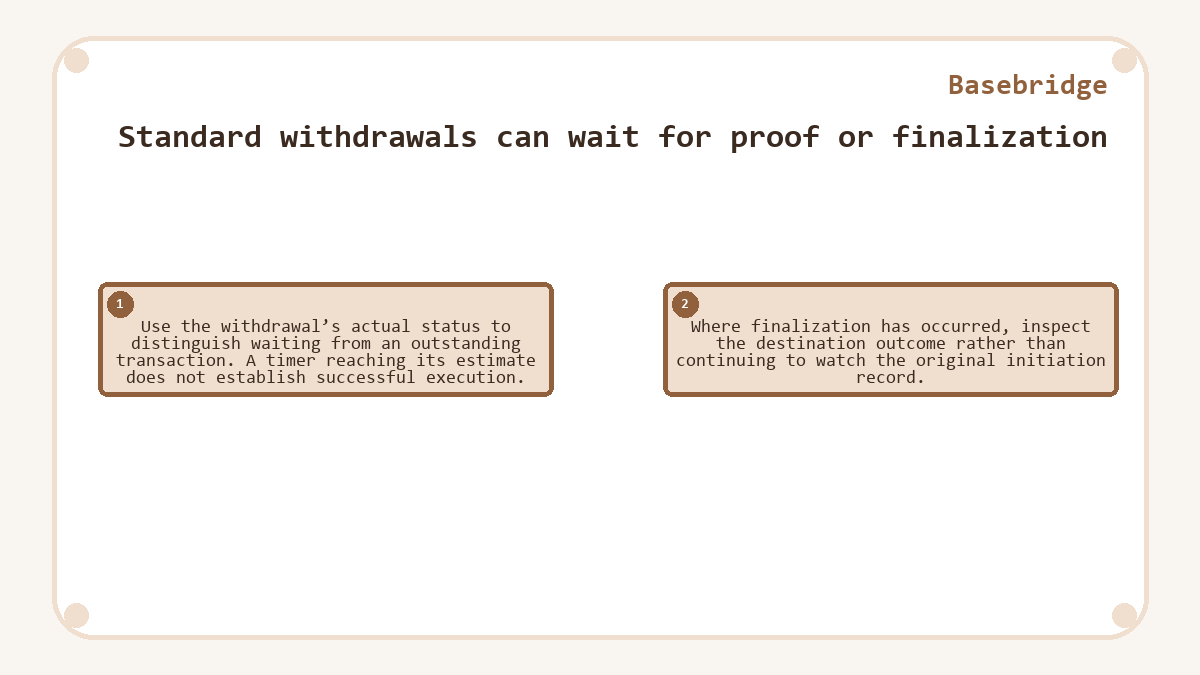
Use the withdrawal’s actual status to distinguish waiting from an outstanding transaction. A timer reaching its estimate does not establish successful execution. Where finalization has occurred, inspect the destination outcome rather than continuing to watch the original initiation record.
Destination transfer records separate delivery from wallet display
When the receiving account holds the expected asset on the destination network, a missing wallet entry can reflect a display problem. Compare the same account and network before changing anything. For tokens, the contract address identifies the asset more precisely than its displayed symbol.
Wallets do not necessarily discover every token automatically. If the destination record establishes receipt but the token remains hidden, adding the verified destination token to the wallet’s display can make that holding visible. This changes the display; it does not submit another transfer. Use the destination contract associated with the actual bridge record.
A current balance can also include later activity. Reconcile the transfer amount against the relevant transaction history rather than assuming the entire present balance came from this bridge transfer.
Different monitoring views answer different completion questions
The most useful view depends on the unresolved state. An explorer describes network activity, while a compatible bridge tracker can connect actions across networks. Neither a status badge nor a balance screenshot contains every relevant detail.
| Monitoring view | Evidence it provides | Limit on the conclusion |
|---|---|---|
| Source transaction explorer | Execution status, block inclusion and receipt logs | Source success alone does not establish destination delivery |
| Compatible bridge tracker | Associated transfer stage and outstanding actions | Coverage depends on the route and tracking implementation |
| Destination transaction explorer | Receiving execution and associated asset movements | The record must match the intended recipient and asset |
| Resolve the missing stage with its corresponding record, then reconcile the destination outcome. | ||
A tracker organizes evidence rather than adding a security guarantee. Keep its labels tied to the transactions they describe, especially when its display differs from an explorer.
When is retrying a bridge action appropriate?
Retrying is appropriate only when the failed action and the route’s supported recovery mechanism identify what needs another attempt. An unresolved display or missing search result is insufficient evidence for sending funds again.
Some failed standard deposit messages support replay after destination execution fails. That mechanism acts on an existing message, subject to its failure conditions. It differs from initiating another deposit, which can create another transfer. Insufficient execution gas or destination contract state can explain why a message failed.
Likewise, an outstanding withdrawal finalization calls for handling that withdrawal’s next action. Repeating its initiation would not complete the earlier request. Identify the existing transaction or message before considering any corrective submission.
Matched destination records provide a useful stopping point
Monitoring can end when the destination evidence establishes the intended delivery and any required bridge action has completed. Match the receiving account, destination asset and delivered amount to the transfer record. Include subsequent account activity when reconciling a balance.
Separate the amount received from the source account’s total debit. Network charges and any applicable route deductions can make those figures differ. The transfer record and transaction receipts establish the relevant amounts without turning a balance difference into evidence of loss.
For an unresolved case, retain the source hash, destination hash if available and the last confirmed stage. Add the exact error or missing action. Those details make the remaining problem specific enough to investigate without submitting a duplicate transfer.
Common questions about Basebridge
Does speeding up a pending source transaction change its hash?
A replacement transaction with different signed transaction data has a different hash. Wallet speed-up mechanisms commonly replace a pending transaction using the same nonce and a higher fee. Track the replacement the network includes, while retaining the original hash to explain the history. Replacement applies before confirmation; it does not accelerate bridge processing after source execution.
What information becomes public when I share a bridge transaction hash?
A transaction hash lets someone locate the associated public blockchain record. That record can expose participating addresses, amounts and contract activity, allowing someone to connect the transfer with other activity involving those addresses. Sharing a hash does not grant spending permission, but it can connect your identity with an account when you post it publicly.
Why can several token transfers appear under one bridge transaction hash?
One transaction can execute contract calls that produce several token transfer events. Those events share the enclosing transaction hash while recording separate movements. Identify the event matching the receiving account and expected destination token. Counting every displayed movement as a separate bridge payment can double-count intermediate contract activity or include transfers unrelated to the final amount received.
Is an old Base bridge interface required to inspect a historical transfer?
Historical onchain transactions remain inspectable without the interface originally used to submit them. The former Base-operated bridge interface was deprecated, so an old bookmark may no longer provide a working tracker. The transaction hash still identifies the original network record. Any replacement tracking interface must support the mechanism used for that transfer.
Which timestamp should I use to measure a bridge transfer?
Use the source and destination block timestamps when measuring the interval between their recorded inclusions. This interval excludes any time the source transaction spent waiting before inclusion. Wallet submission times and tracker update times describe different events, so comparing them can produce a misleading duration. A block timestamp also does not independently establish when the transaction reached finality.